![]() |
![]() |
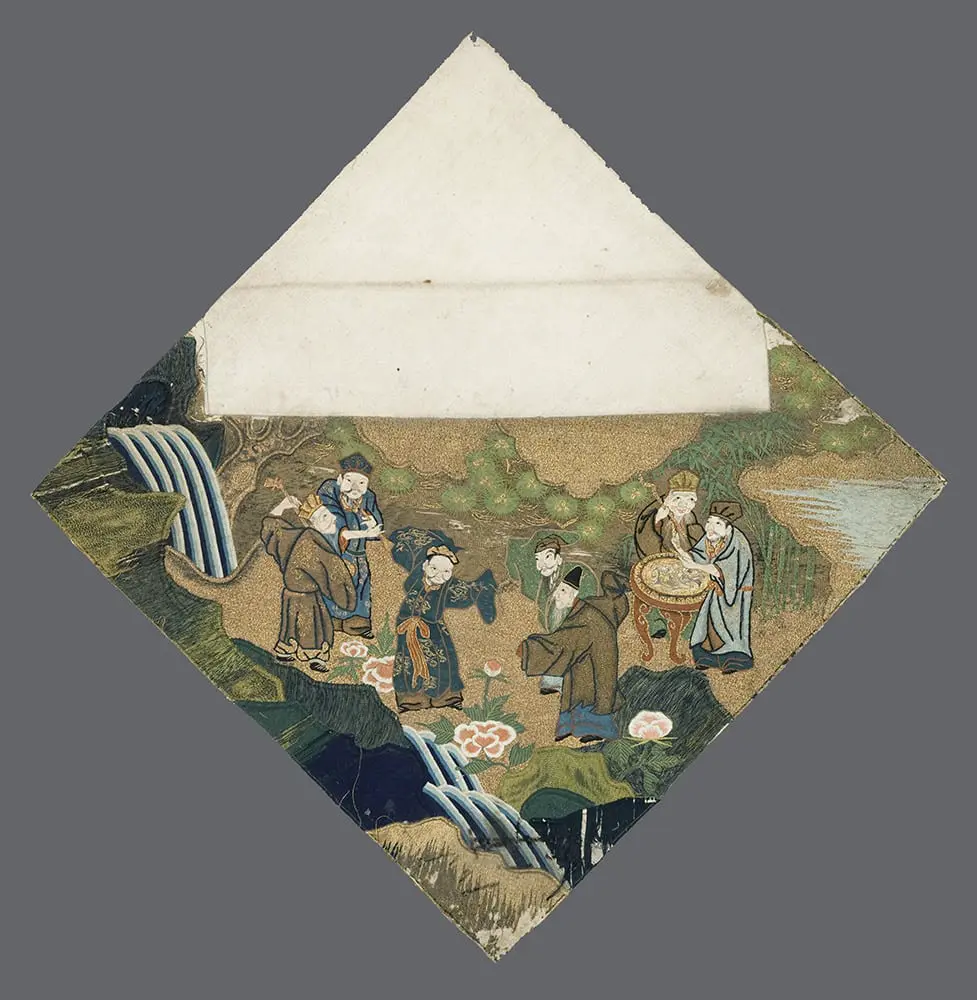
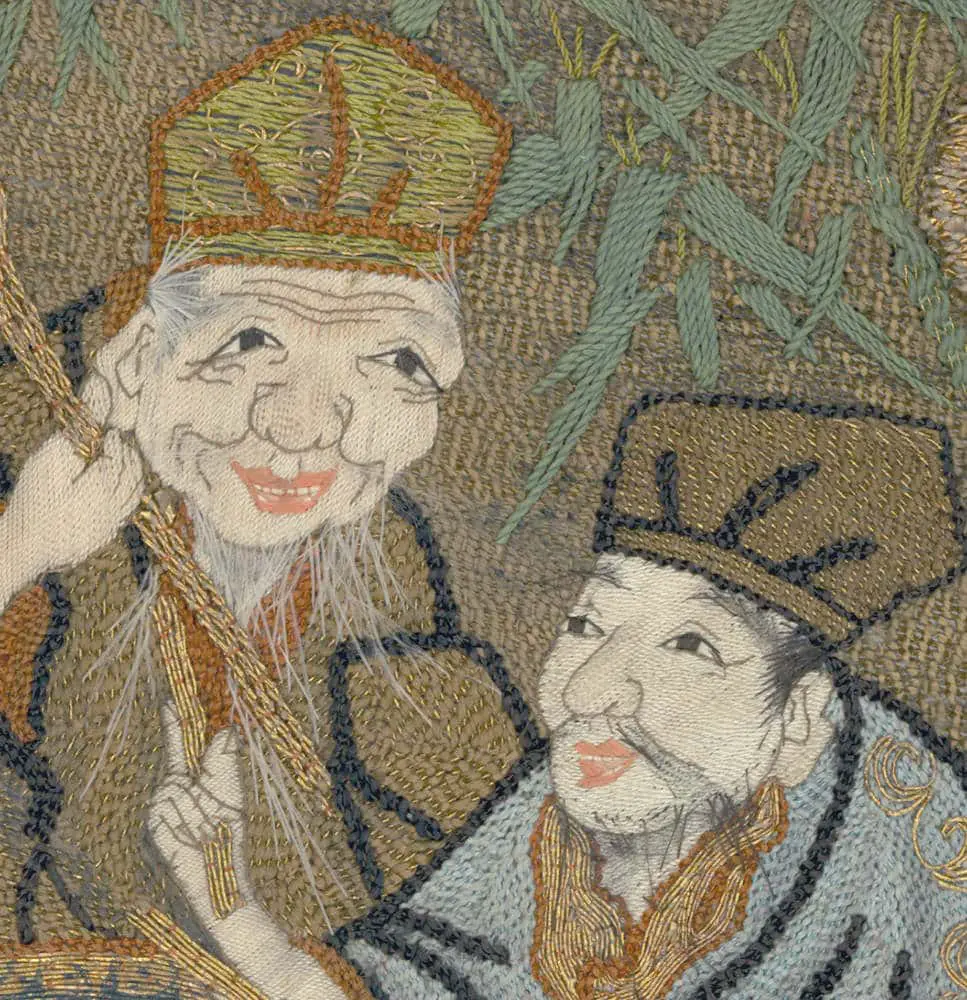
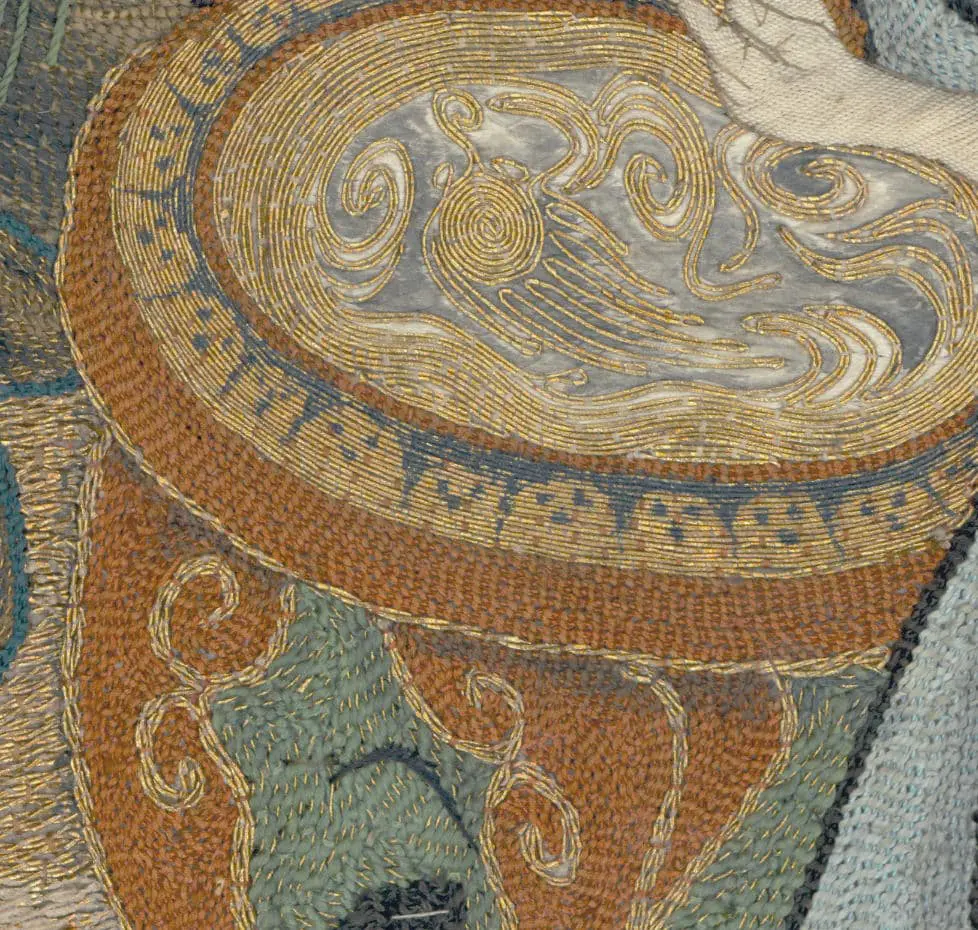
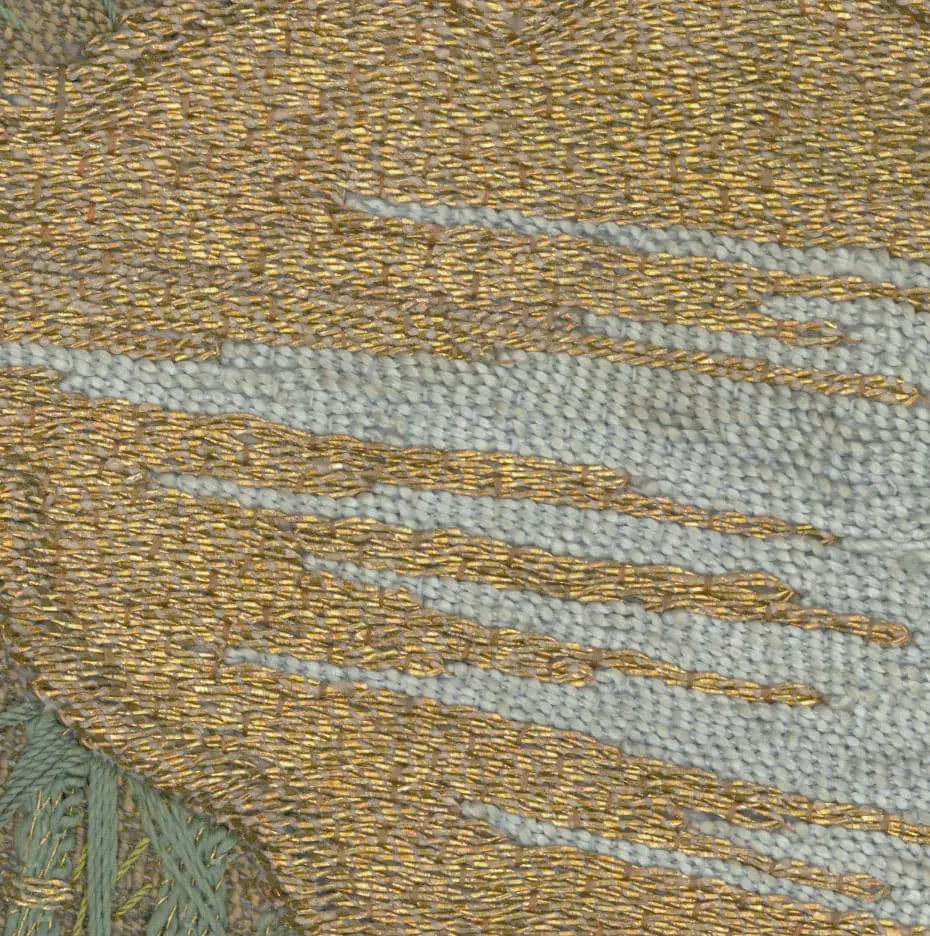
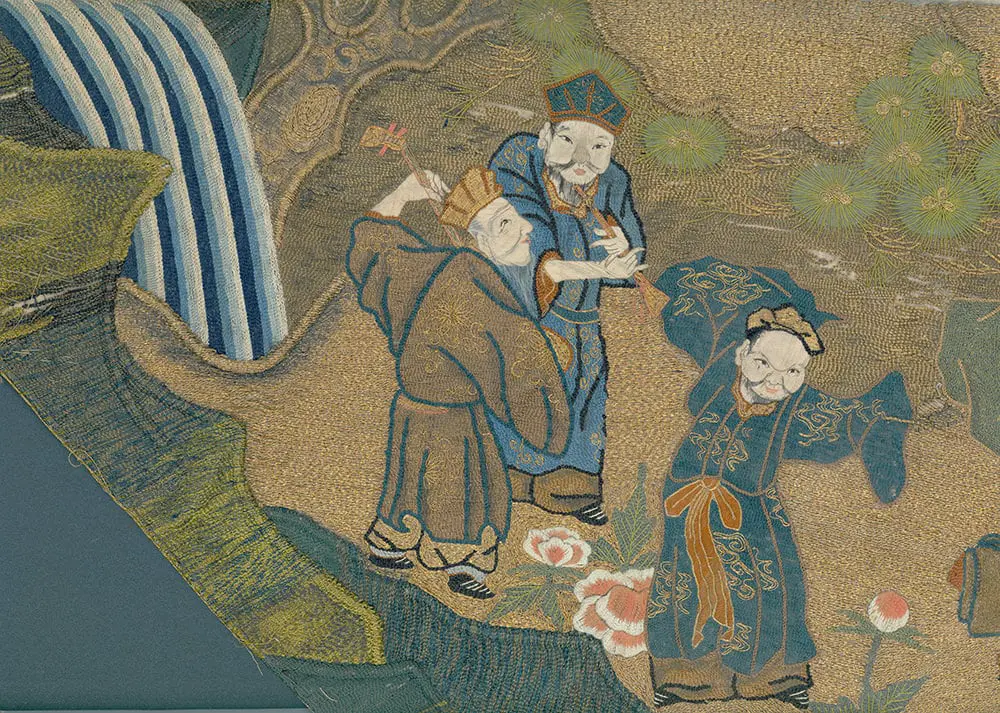
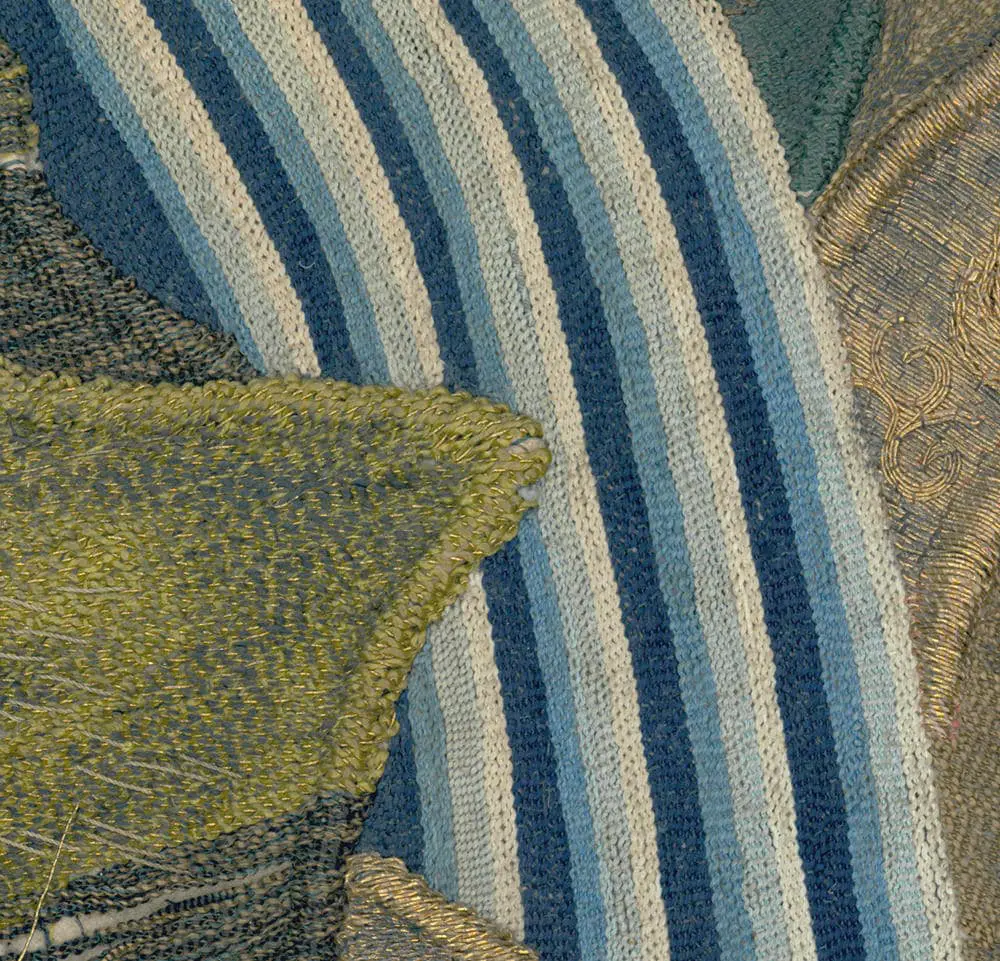
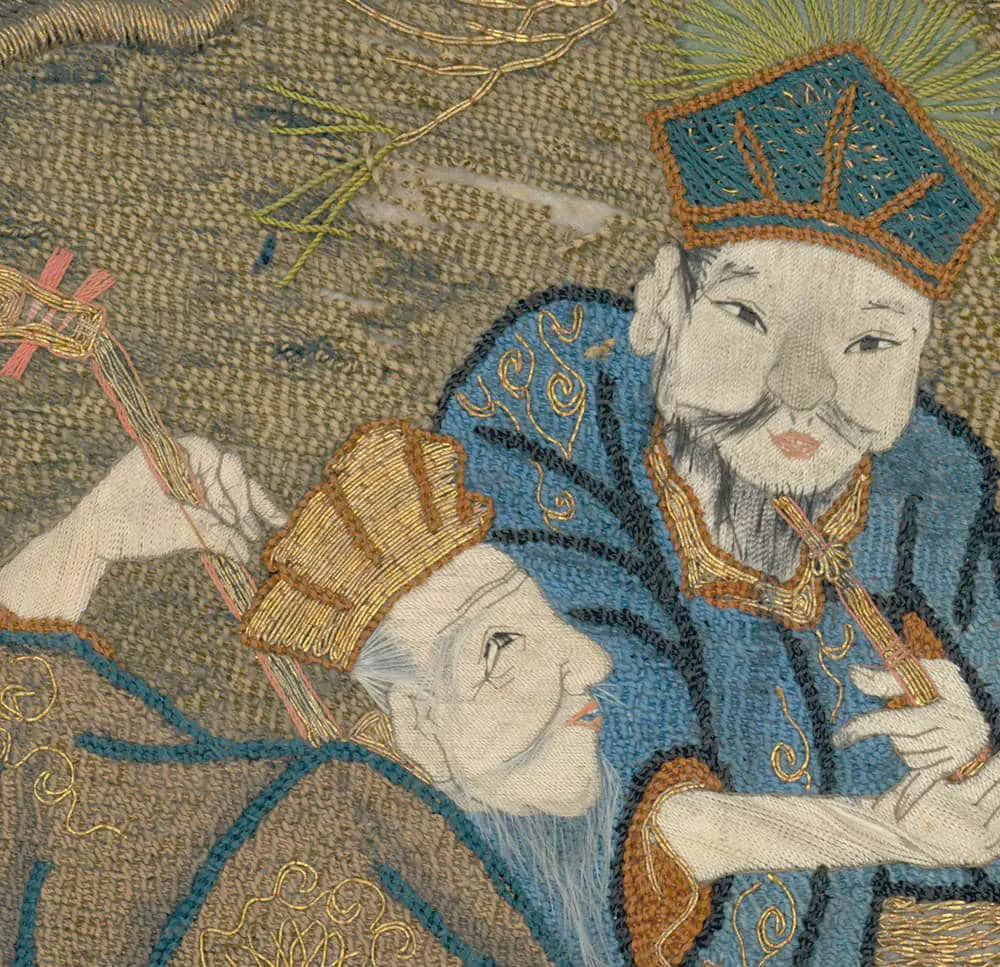
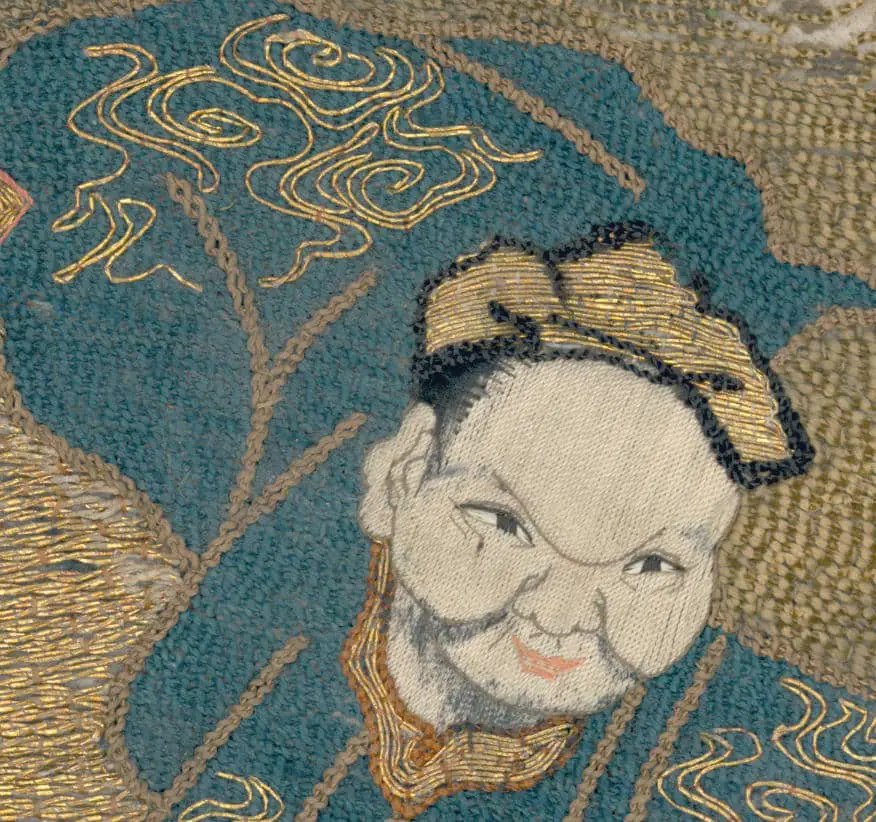
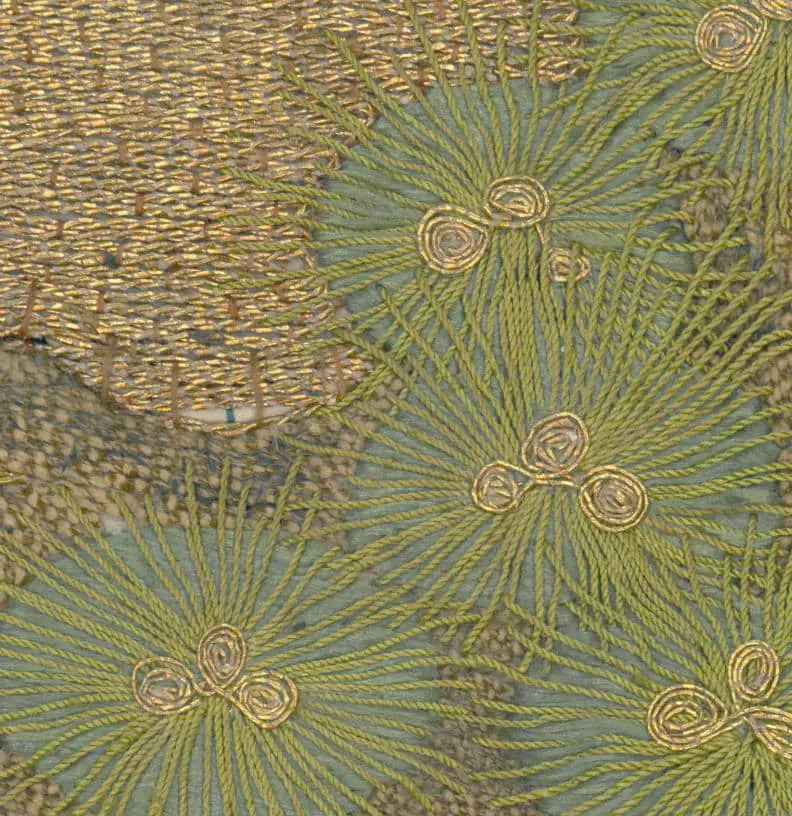
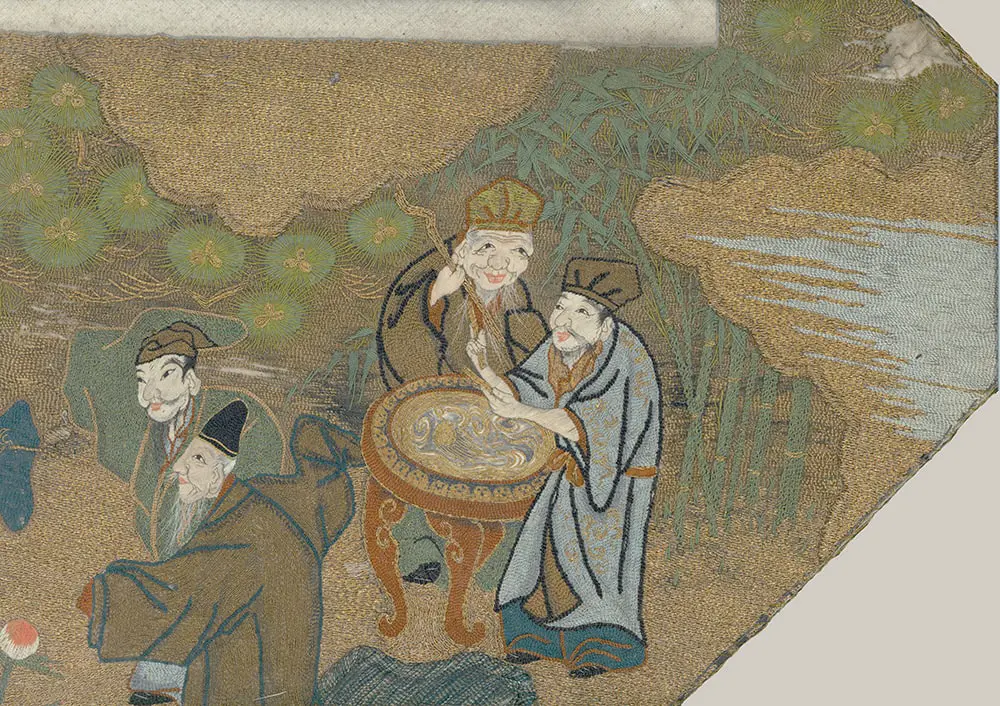
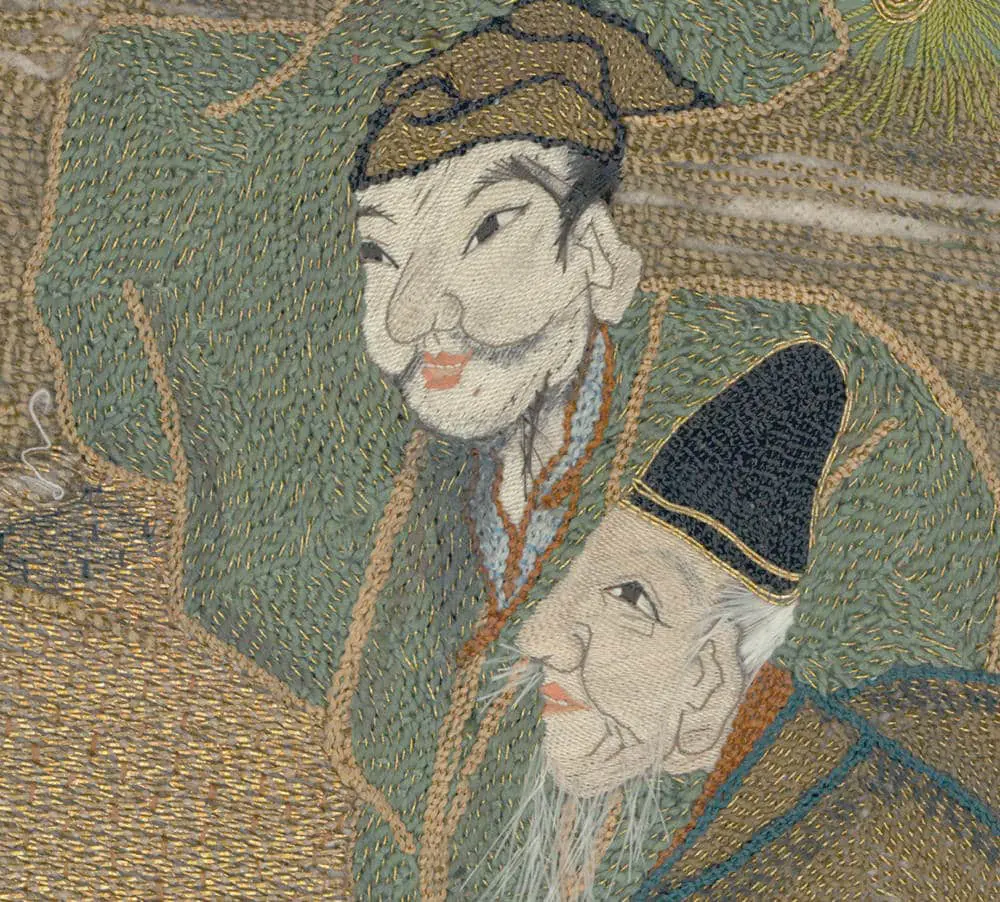
Japan Mid-Edo (1650-1800) $15,000.00 A very rare uchishiki that has a completely embroidered design of seven male figures by a stream in a bamboo grove who wear the loose robes, drooping caps, sparse hair, and beards of Chinese scholar-gentlemen. The embroidery is a three-dimensional style involving various techniques that emphasize depth and texture: there are many instances of embroidery over embroidery. There is evident a profuse use of gold-wrapped threads in both the fine couching as well as the other embroidery. Some of this gold-wrapped embroidery is utilized in rare ways: some threads intentionally have the gold wrapped in such a manner as to leave about 50% of the thread core viewable; in other instances, the gold-wrapped threads appear in and out of the background; these results in a special effect. The embroidery is accomplished on a hand-spun and woven cotton. The lining cloth that backs this embroidery is ramie (‘asa’ in Japanese). Good condition: most of the damage is evident in the images, with the two main ones including a black burn mark on the lower part (at the falls), as well as a balding spot on the extreme lower corner; there are other various small imperfections. Unfortunately there are not many extent uchishiki of this age, as one might expect from the fact that such altar cloths were placed in terrible physical conditions - beneath oil lamps, candles and incense burners. 37” x 38” at highest and widest points; 27” x 27” along sides. ‘Giving an uchishiki to a temple was meant to be a prayer for the departed one to be purified and to become the spirit of an ancestor and then to be reborn again into this world’. The subject of this Buddhist altar cloth is “The Seven Sages of the Bamboo Grove”. During the Western Jin dynasty of China in the 3rd century, there existed a group of seven men who exhibited behaviours unrestrained by traditional and social conventions, spending much of their time playing music, composing poems, drinking, and practicing ‘qingtan’ (pure conversation)—a Taoist-influenced form of philosophical discourse. They were supposed to be widely respected as high-minded scholars, commanding prestige for their learning and personal characters, but actively sought to evade the taint of the corruption of officialdom. Philosophically, they were said to be follow the ideas of Zhuang Zi, one of the earliest thinkers to contribute to the philosophy that has come to be known as Taoism, or school of the Way. These men recognized nature - the origin of every existence - not as being chaotic and hostile, but as a well-ordered place without any contradictions and conflicts. And society, as a part of nature, therefore has to be harmonious and without conflicts as long as it is not destroyed by artificial definitions and arrangements. References to the Seven Sages of the Bamboo Grove are abundant in Chinese and Japanese art and literature. Why would a Taoist-themed subject-matter be incorporated onto a Japanese Buddhist altar cloth? In Japan, the motif of the Seven Sages of the Bamboo Grove was known as early as the ninth century. During the tumultuous Muromachi period (1336-1573) in Japan, images of the Chinese recluses might have been especially appealing to Zen Buddhist priests who wanted to retreat into nature in order to evade the social upheaval of that period. Moreover, the ‘Seven Sages’ motif may have connected to a broad range of Japanese audiences, who may have felt trapped in a society where military prowess, wealth, and social rank determined status. The sages took on connotations of superior learning and intellectual sophistication, making it an appealing theme for those wishing to raise their cultural profile, including aristocrats, priests, warriors, and merchants. . This theme was widely represented in Japanese art from the sixteenth century to the Edo period (1615–1868), with this altar cloth a superior example. Who actually were the seven sages? First among equals was Ruan Ji, who epitomized those qualities which made the group so highly regarded over the centuries. Ruan Ji was highly talented, having an ability to avoid the chains of the morality and traditions of the Imperial Court, but was unbalanced and undisciplined. He was eager to banish his temptations. It was Ruan Ji who honoured the ancient Taoist sage Zhuangzi. Ruan Ji was also known to be stubborn and self-willed, proud and independent, who sometimes would wander away on the hills and forget to return, and at length come back crying bitterly; at other times he would shut himself up with his books and see no one for months. Once inspired by an idea, he forgot about everything in the world, causing many who knew Ruan to consider him a madman. Another sage was Ji Kang, an author, poet, Taoist philosopher, musician, and alchemist. As a thinker, he wrote on longevity, music theory, politics and ethics. Ji Kang was highly critical of Confucianism and challenged many social conventions of his time. As such he was considered scandalous and seditious. The third was Shan Tao, a good friend of Ji Kang. Shan Tao was an official who ultimately reached the rank of Director of Instruction, one of the three highest offices in China. At one point Shan Tao put Ji Kang’s name forward as his successor. This recommendation only alienated the latter and irrevocably damaged their friendship, because the act suggested that Shan Tao did not fully understand Ji Kang’s character and his rejection of governmental service. The fourth sage was Ruan Xian, nephew to Ruan Ji. A lute musician, the Chinese lute is named after him: ‘ruan’. The fifth was Wang Rong, a child prodigy and later, a major official in the Jin dynasty. He was the most worldly of the Seven. He and his wife could spend the entire night counting their coins using toothpicks as tokens. He dug the seeds out of the pears of his gardens before they were sold in the market, fearing others would plant those seeds. Xiang Xiu, the sixth, was also a good friend of Ji Kang, and is said to have written a commentary on the major third-century BC Taoist philosophical text the Zhuangzi. Lastly, there was Liu Ling, a poet and scholar. Little information survives about Liu’s family background, though he is described in historical sources as short and unattractive, with a dissipated appearance. Popularly regarded as an eccentric, Liu was notorious for his love of alcohol. The earliest depictions of him, on tombs in Nanjing, show him drinking wine from a gourd, and his most famous work is a poem titled "In Praise of the Virtue of Wine. 2635Contact Us About This Item: |